Blog, Writing

The Writing Process

It’s always fascinating for me to listen to authors talk about their writing process, the way they reach that creative catharsis that results in a book. Or a story. Or an essay. Or a poem.

Some authors start with a character. This character can appear in a dream, or she can seep into the author’s subconscious, stalking the author until the author has no choice but to write her into existence. There is no plot yet, no specific outline of a story – just a character. Once this character is written, she takes the author by the hand (hypothetically of course) and leads her into the story. The result is the plot, the what happens, and it’s as much of an adventure for the author as it is, later, for the reader. It’s a process of discovery.

Other authors have the seed of a plot in their minds. They heard from a friend, or from a stranger, the intricacies of an event that were captivating, and that started the writing process. They explore the importance and ramifications of said event, look at the “what happens” and “how it happens” and then build characters to fit this plot. It’s still a process of discovery because even though the skeleton of the plot/story is known, the words that make the story real for the reader are discovered as the authors write their stories.

And then there are those authors who simply sit at a blank screen, or a blank page, and just start writing, letting their muses take them into the worlds they’re creating, without so much as a single preconceived notion of the final product.

It’s hard to say which is the best method, and I’m sure there are some people who swear by one method or another. I don’t think there’s a perfect method, but rather one that works best for you and for the given project.

In a piece of non-fiction, the plot is already known, so starting with a structure, an outline, might work best. If a character comes and doesn’t leave you alone (I’ve had these), run with the character until you get a clearer picture of the plot, and then go from there. If you don’t have either character or plot, but you want to write something, then write, and see where that writing takes you.

In the end, what’s important to keep the writing alive, the creativity moving, and the muses around, is to just keep writing. For a few minutes, a few hours – whatever. Just write. (INSERT the Nike “Just do it” commercial…) Write it down. Then revise it. Chop it up. Change it around. Add to it, delete from it. Mold it like you’re molding a piece of clay until the end result is just right.

Blog, Writing

I Am

I Am – by A. P. Alessandri

I am from the Andes and the Amazon rainforest,
and from the warm sands of SoFla.
A mountain girl in the magic city,
bred with frijoles, sancocho and Burger King.
A speaker of romance whose tongue
becomes a contortionist–
Erre con erre cigarro, erre con erre barril.
Roll your tongue, mija, ole, niña.
A gringa among my people.
A Latina among my people.
Often confused for a stranger.
A hyphen in a world that devalues hyphens.
A hyphen in a world that overvalues hyphens.
A Paisa and Miamian born in Queens,
who celebrates Noche Buena with
buñuelos and natilla and El Niño Dios
then spends Christmas morning
unwrapping Santa Claus under the
six-foot fraiser fir from somewhere up north.

My father used to say in Latin,
de gustibus et coloribus non disputatum,
but we still argued about our differences
and the colors of our people.

I am my mother’s daughter,
a pseudo- perfectionist
who dreams of the Blue Ridge Mountains,
while moving to Cumbia and Vallenato.
I am my father’s daughter,
a seeker of justice
torn between the Ave Maria‘s and
the duplicity of the Church.

I am me.
Broken, idealistic, indecisive, strong, whole.
I am my mother’s mother and my father’s father.
Or my mother’s father and my father’s mother.
I am them, and yet I am not them.
I define binary opposites.

I am.

Blog, Travel, Writing

Another day in a beach town

The rain threatens late today. It starts as a low, long rumble as we take an afternoon stroll on the beach. Towards the north, where the land and sea blend together into a solitary line, the dark clouds form shadows of mountain peaks and I almost forget that we’re in Florida’s east coast; there are no mountains here. The rain never comes, though.

The afternoon stroll was a good ending to a good day. I could get used to days like these: taking morning strolls on the beach; building sand castles and watching small shells dig their way back into the sand, far away from us and the birds that feed on them; swimming in the pool, trying out water aerobics; napping after lunch to the sound of the waves coming and going; taking an afternoon drive or walk or just sitting in the balcony, writing. I could absolutely get used to this.

I’ve been productive today, with my writing classes. For my children’s writing workshop, I finished a superhero assignment that I thought would dismantle me. One of my first sketches included Super Mom, whose powers include seeing all (a la having eyes in the back of her head – yes, clichéd, I know) and who constantly battled her nemeses Grumpy Grandma and Know-it-All Friend. A bit lame, and more a platform for a disgruntled mom than a kid’s superhero. Though I might revisit these “characters” even if for a comedic post. What I finally submitted was much better than this. I hope.

In my personal essay workshop, we had a guest author pop in, and it was very interesting. Christine O’Hagan was kind and answered our questions candidly. I always find it helpful to listen to the advice and wisdom of authors who know the ropes, who’ve published in the field I’m interested or tackling. I particularly loved when she said (and I’m paraphrasing) memoirs need to be written with compassion and humor. Compassion and humor – so important. In the process of writing my memoir (and it’s still very much a work in (early) progress), I’ve come to understand that memoir writing is not a vendetta, it’s not the opportunity to get even with someone. Memoir writing is writing without judgement, to understand and make peace with a past and with people in that past. It’s a journey and an exploration about an event (or events) and person (or people) that were significant in life and that, by sharing this experience, others can understand shards of their own lives.

Now, I sit here in the balcony. My son is asleep (finally – no nap today), and my husband is next to me, on his iPad. We’re quiet, and the only sounds that come are from the waves, the breeze, and the keys on my laptop as I’m typing. It’s a beautiful rhythm. Our vacation ends in two days, and I don’t want it to. I want to stay here, in this beach town, indefinitely. I want to get used to this routine.

Blog, Travel, Writing

Scenes from a Beach Town

The smell of rain is thick and suffocating. It fills my lungs and I gasp a little. It’s that thick.

In the morning, the surfers were out in the water. We watched them from our balcony overlooking the Atlantic Ocean. They formed a jagged line out there, small on their surfboards, and they glided, moving with the same rhythm as the waves. I don’t know whether they spoke or yelled to each other; the waves drowned out any noise outside their own rhythmic whoosh as they hugged the sand, then slowly crept back into the deep.

A soft rumbling of thunder tells me the pool is out of the question, something my son is not too happy about. Instead, we climb into our car and take a small drive, stopping first at Starbucks for some much-needed coffee. There, my son orders a cookie, then pays for it, by himself. He’s almost four and proud of his accomplishment.

My son is hungry, so we head to Pistilli’s Italian Restaurant and New Jersey Style Pizza in Melbourne. We’ve been to this place before and loved it; this time is no different. We scurry from the car into the restaurant; it’s started drizzling by now, a small mist that is enough to dampen but not soak. Inside, the lights are dim, the curtains half-drawn. Large posters featuring The Godfather and The Sopranos frame the entry way. A sign in the front tells us “Welcome – Please Seat Yourself” – and so we do in a booth by the back, near the kitchen.

The decor is simple and Italian – pictures of wine bottles and grapes, Italian chefs, a small decorative sign that says “Good Food, Good Wine, Good Friends.” Tammy, our waitress, rushes from table to table; she’s alone today, but she doesn’t miss a step or mix an order. Soon, we’ve ordered our meal: two slices of cheese pizza each for my son and me, and chicken parmigiana with pasta and a side salad for my husband. While we wait, Tammy brings us some bread, and we sit back, listening to “Shake, Shake, Shake Senora,” which reminds me of the movie Beetlejuice every single time. In the kitchen, the sizzling, clanging, and chopping seems to move to the song.

When the food gets to us, we dig in. Perfection. My pizza is just right: not too much sauce, and it’s more sweet than spicy. The thin crust is not crispy, and the cheese stretches when I take a bite. This is how I like pizza. And the slices are large. My son eats an entire slice; I eat two. My husband likes his meal, too, though he eats half of it, along with half of a pizza.

We are back in the apartment. Our stay is courtesy of family, and we’re grateful. This small break by the beach is what we needed to unwind, to let the ocean sweep our worries and stress and take it back out to sea, so we can revive and renew our energies.

My son, who claimed – “I’m not tired! – in his strong, defiant little voice, is passed out on his air mattress. His soft snores tell us he was, in fact, quite tired. The sliding glass door is shut, but the waves’ rhythmic lullaby reaches us and I think we, too, will take a nap.

Outside, it’s still dark, though the east is showing some breaks of sunshine peaking through puffs of clouds. A solitary surfer remains in the water, sitting on his board. I wonder what he’s waiting for, bobbing with the waves.


Blog, Writing

Mamá Adela

I never met Mamá Adela, my paternal grandmother. She died in the sixties from breast cancer, when my dad was still a priest. From the stories my Tio Germán tells me, my dad was in Chile when he received word of my grandmother’s declining health. He asked the Church, and was granted, a transfer back to Manizales, where he spent his time by her side.

Like my dad, she smoked cigarettes until the end. My dad often told me how he’d sneak some to her, a last gusto, because at that state, why deny her simple pleasures? Perhaps smoking was a comfort for her, a tool to embrace a death that was hers. Her husband, my grandfather, had died ten years earlier in a motorcycle accident. He was too young. Maybe she saw her sentence as a way of seeing him once more. Maybe she’d missed him, especially since the children were all grown. Or maybe she shuddered at the thought of being bound again, in the afterlife. I don’t think the latter holds true to her memory, though.

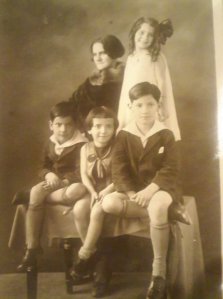
In the picture I have of her, tacked on a collage on my living room wall, she is still young. She’s sitting, staring off to the side, her hair a neat, dark bob, her thin lips in a line. No smile. I don’t think it was customary to smile in those days, but I wonder if she had other reasons not to smile. The photograph is circa 1934 and four of her six children are pictured; the final two would follow in the years to come. My dad, the youngest here, was about four or five. Germán, the oldest, must have been about eight. In the photograph, Ruth is standing next to my grandmother, behind the three sitting boys: Rodrigo, my dad, and Germán. The only ones smiling are my dad and Tia Ruth. Tio Rodrigo’s lips are also in a straight line, his eyebrows scrunched;  Tio Germán doesn’t scowl nor does he smile. When I was a child, I loved this photograph because it’s the only photo of my dad as a child. All I have of my dad’s youth are stories. This is one, tangible proof that he was, in fact, a child – funny haircut and bright, wide eyes and all.

I wonder what my grandmother felt, sitting beside her children. Did she feel divided? Did she care that she had no choices? I wonder if that’s why she didn’t smile, why she bore her cross, that woman born with the century, without complaining but without smiling. I look at her and want to know her, understand her, as if that is the key to understanding part of who I am.

I ask Tio Germán, the eldest of her children and now well into his eighties, about her and he tells me stories of her my father never did. She had poor health, unidentifiable pains the doctors couldn’t name, so they sent her to Aguadas, a valley near Manizales that provided much-needed warmth for her aches; Manizales was just too cold. She went to Aguadas with my dad whenabout six or seven, while my uncle stayed behind with my grandfather. I don’t know how the others were divided, but I wonder whether my grandmother yearned for that solitude, for that brief period of independence.

The stories I’ve heard of her are conflicting. My dad referred to her as docile, sweet; my cousins, the ones that met her, remember her as stoic, stern, and the one who punished.

In this photograph, I can see traces of both women.

Blog, Writing

Story Finished

I finally finished the story on which I was working. Yeah! I can breathe relief, and go back to grading papers. I started it last summer, put it away for an entire academic year, only to pick it back up this summer. The revision was brutal. It’s my least favorite part! But I’m done. Finished. (I think). I recognize that a story is never, truly finished (until, perhaps, it’s published, but even then it can always be improved somehow, someway).

So now I’m sending it out to a few places, hoping to finally get a break.

Regardless, I’m happy with it. I feel like I’ve just given birth: exhausted, in pain, but exhilarated and thrilled.

I can now devote some time to this other story, one whose idea was conceived last summer (it was a busy, creative summer!). This is a longer piece, though I’m hesitant to say I’m embarking on a novel. It’s too scary a thought right now. I have my memoir to think about, to add to. But this story just doesn’t let go of me. Wherever I turn, it’s there. The characters haunt me, asking me when I’m going to write them down. I have scribbled notes, written character sketches, and drafted a scene which I’m thinking of carving into a short story. I can tackle this one part at a time.

Maybe I’ll go back to reading John Dufresne’s  Is Life Like This? A Guide to Writing Your First Novel in Six Months. There’s no way I’ll be able to write the entire thing in six months (I do have a day job and a family that compete for my time), but, maybe it’ll help me get started.

It scares the shit out of me, though. A novel. Maybe if I approach it like I did my Master’s thesis. Once section at a time. Maybe then it won’t seem so daunting.

Or, maybe I’ll go back to working on my memoir. I was about a third in before I stopped to focus on shorter pieces. Maybe.


Blog, Writing

Rules for Fiction Writers

Last summer, during my Postcard Memoirs course  from UCLA’s Writers Extension online program, I was given a heap of helpful and useful links. One of those, in particular, I’ve found myself coming back to over and over again, and it’s not even for non-fiction!

The article, if you want to read it all, is “Ten Rules for Writing Fiction,” and it’s a compilation of several authors’ do’s and don’ts for writing fiction. Some of these rules (actually, many of them) can also be applied to some areas of nonfiction, especially memoir (short or long).

The following are among my favorites.

Elmore Leonard — “Never use a verb other than “said” to carry dialogue. The line of dialogue belongs to the character; the verb is the writer sticking his nose in. But “said” is far less intrusive than “grumbled”, “gasped”, “cautioned”, “lied”. I once noticed Mary McCarthy ending a line of dialogue with “she asseverated” and had to stop reading and go to the dictionary.”

“Never use the words “suddenly” or “all hell broke loose”. This rule doesn’t require an explanation. I have noticed that writers who use “suddenly” tend to exercise less control in the application of exclamation points.”

“If it sounds like writing, I rewrite it.”

Diana Athill — “Read it aloud to yourself because that’s the only way to be sure the rhythms of the sentences are OK (prose rhythms are too complex and subtle to be thought out – they can be got right only by ear).”

Margaret Atwood — “Hold the reader’s attention. (This is likely to work better if you can hold your own.) But you don’t know who the reader is, so it’s like shooting fish with a slingshot in the dark. What fascinates A will bore the pants off B.”

“You most likely need a thesaurus, a rudimentary grammar book, and a grip on reality. This latter means: there’s no free lunch. Writing is work. It’s also gambling. You don’t get a pension plan. Other people can help you a bit, but essentially you’re on your own. Nobody is making you do this: you chose it, so don’t whine.”

“Don’t sit down in the middle of the woods. If you’re lost in the plot or blocked, retrace your steps to where you went wrong. Then take the other road. And/or change the person. Change the tense. Change the opening page.”

Roddy Doyle — “Do keep a thesaurus, but in the shed at the back of the garden or behind the fridge, somewhere that demands travel or effort. Chances are the words that come into your head will do fine, eg “horse”, “ran”, “said”.”

Helen Dunmore — “Finish the day’s writing when you still want to continue.”

Geoff Dyer — “Keep a diary. The biggest regret of my writing life is that I have never kept a journal or a diary.”

“Do it every day. Make a habit of putting your observations into words and gradually this will become instinct. This is the most important rule of all and, naturally, I don’t follow it.”

Anne Enright — “The way to write a book is to actually write a book. A pen is useful, typing is also good. Keep putting words on the page.”

Jonathan Franzen — “Fiction that isn’t an author’s personal adventure into the frightening or the unknown isn’t worth writing for anything but money.”

Esther Freud — “Find your best time of the day for writing and write. Don’t let anything else interfere. Afterwards it won’t matter to you that the kitchen is a mess.”

“Don’t wait for inspiration. Discipline is the key.”

Neil Gainman — “Remember: when people tell you something’s wrong or doesn’t work for them, they are almost always right. When they tell you exactly what they think is wrong and how to fix it, they are almost always wrong.”

PD James — “Increase your word power. Words are the raw material of our craft. The greater your vocabulary the more effective your writing. We who write in English are fortunate to have the richest and most versatile language in the world. Respect it.”

“Don’t just plan to write – write. It is only by writing, not dreaming about it, that we develop our own style.”

“Write what you need to write, not what is currently popular or what you think will sell.”

Al Kennedy — “Have humility. Older/more experienced/more convincing writers may offer rules and varieties of advice. Consider what they say. However, don’t automatically give them charge of your brain, or anything else – they might be bitter, twisted, burned-out, manipulative, or just not very like you.”

“Have more humility. Remember you don’t know the limits of your own abilities. Successful or not, if you keep pushing beyond yourself, you will enrich your own life – and maybe even please a few strangers.”

“Remember you love writing. It wouldn’t be worth it if you didn’t. If the love fades, do what you need to and get it back.”


Blog, Writing

Memory Vs. Facts

As one who writes memoir and personal essay, memory is at the front of my creative needs. When I’ve taught the memoir in my composition courses, I tell my students that memoir is true insofar as memory permits. And this is because memory is fragmented. When we remember, we do so it bits and pieces, in starts and stalls. We might not remember the entire scene as a movie developing from start to finish. We remember enough of that scene to piece it together and to know what happened.

I find myself now, marveling at how deceiving memory can be. I’m revising a short story I wrote, hoping to send it out to a few places. It’s the story of a mother who was exiled to the States after witnessing a murder during the drug war days of Medellin and who is now trying to go back and find the kids she left behind.

I thought I had the dates all down. The last time I went to Colombia was in 1992… I think. I was always convinced it was 1992, but now that I’m dissecting dates, I wonder if it was ’91 or ’93. I (think I) was thirteen. Anyway, the last time I went to Colombia I was in Manizales and kissed a boy who had been my pen pal since ’89 when I met him at my aunt’s music school – La Rafael Pombo. It wasn’t my first kiss, but it was my first kiss with a boy I liked (my first was on a dare). After that trip, it was no longer safe to go. Family came and visited, but we never went back. I’d hear my father talking about car bombs, about an explosion in Unicentro, about my cousin getting hurt (but thankfully not seriously). In my mind, the worst of the worst with the drug wars happened in the mid-to-late 1990’s.

Now that I’m writing my story, I had these dates preset by my memory. I had to check my facts, though, and would you imagine my surprise when I realized the heydays of the Medellin Cartel were in the late 80’s and Pablo Escobar, that much-hated and much-revered drug lord (depending on whom you asked) was killed in December of 1993? Right around that last time I was in Colombia. Such is memory, I guess.

Now on to changing some specifics in my story to match the facts.

Blog, Writing

What Motherhood Means to Me

I became a mother when Hurricane Dean was crossing over Jamaica in 2007. In the midst of reading the last Harry Potter book, my water broke, and when we reached the hospital, my son held on just long enough to be born on a Monday morning.

To describe those moments of first meeting him is next to impossible. Helplessness and awe, exhaustion and exhilaration accompanied those first moments when I saw this little creature, wrinkled, bloody, pink and hairy. I took in his scent, the sound of his whimpers, the feel of his skin, still flaking. There was nothing in this world I wanted to be more than his mom.

There still isn’t.

But motherhood is a different game today. Today, I have choices. Do I breast feed, or bottle feed? Do I use disposable diapers and further the decay of our earth, or use cloth diapers and simply waste water? Do I start solids at four months, like my pediatrician recommends, or at two months like my mother insists? My mother is adamant on imposing her views; after all, she raised me and I turned out just fine, didn’t I?

Motherhood is a tug of power.

When I go to the grocery store or the mall, there are other mothers, their children in strollers, arms, slings. Older children are running, crying, throwing, laughing. If a toddler is having a tantrum, other mothers throw disapproving glares. Other mothers immediately criticize and judge in whispers loud enough for the intended target to overhear. How dare that woman take her month-old-infant out to a public place. Or, I would never think about having my child out without shoes or socks. The comments differ, but the tone remains harsh, critical, unforgiving.

As part of this club, I’m not exempt. Every action I take with my son is analyzed. Whether I have my son sleep in his room or co-sleep with us. Whether I take away the pacifier or the bottle at two-years-old. Whether I let him eat pizza, or chocolate. Whether he watches TV or not. Usually, my mom is at the front of the inquisition, but I hear this from other young moms as well. Every member in this exclusive club believes only she knows best. That there’s only one way of doing things right and every other member is scarring her child for life.

Motherhood is full of judgment.

More personally, though, motherhood means a re-negotiation of personal identity. It means losing myself in a new category of craziness and tearing myself into several women, one for each duty I have to accomplish: as wife, as mother, as daughter, as professional. It’s easy to lose sight of who I am in this constant re-assignment of roles.

But ultimately, I revel in the benefits that come with motherhood. When my son, now almost three, leans over unexpectedly and embraces me, his tiny arms wrapping around my neck and his lips smacking against my cheek. When he stops in the middle of racing his trains and looks up at me, smiling, and says, “Mommy, I love you.” When he asks for “agua, please” and then, without prompting, says, “Thank you, mommy.” When he wakes up in the mornings and runs to our room, the pat, pat, pat of his little feet sounding on the wooden floor.

Motherhood means seeing time rush before my eyes, without stopping or hitting pause. I can’t blink because if I do, I miss another kiss, another I love you.

This is what matters most about motherhood.

7/2010

Blog, Writing

I Stopped Writing Poetry

11/2010

I stopped writing poetry
because I had a day job and night job
and both left little time for socializing,
so I sacrificed poetry in order to
go to late night movies, to travel,
veg out in front of a TV because
I didn’t want to feel – I was over it –
and poetry made me feel.

I stopped writing poetry because I fell in love
And everything I wrote was clichéd, Hallmark
Versions of serious poetry, and
If I couldn’t write serious poetry, then
why write poetry at all?

I stopped writing poetry when the
Scribbled verses I clutched in my lined paper
Were savagely stricken with black ink
By a “real” poet who told me I was no poet;
He circled only two words in those four verses
And said, “Here, you may have a poem.”

I stopped writing poetry when
Every poem I wrote fell into a
Been-there, done-that
Category. No originality,
The “real” poet told me. You’re
Too late. Find something new.
Writing about a Latino identity is so
Nineteen-eighties. Perhaps if I’d been
In my twenties, or thirties then, and
Not still in elementary school,
Well, maybe then I would’ve kept writing poetry.

I stopped writing poetry when I started
Writing prose, because I was a good writer,
but a bad poet. I had stories to tell and
Those took more white space than a poem did,
though I never really stopped writing poems.
Nestled in my prose, were poems,
But not poems of a “real” poet, so I stopped writing
Deliberate poems

Except when I hurt
Or when the hurdle of emotions become
Too much to write in prose.
When I have to seek the better evil of
Writing or paying someone for my sanity.
Then I write poems.